how-exception-handling-works-in-the-context-of-drf.md•4.04 kB
### How exception handling works (in the context of DRF)
DRF has an excellent guide on how exceptions are being handled, so make sure to read it first - <https://www.django-rest-framework.org/api-guide/exceptions/>
Additionally, here's a neat diagram with an overview of the process:
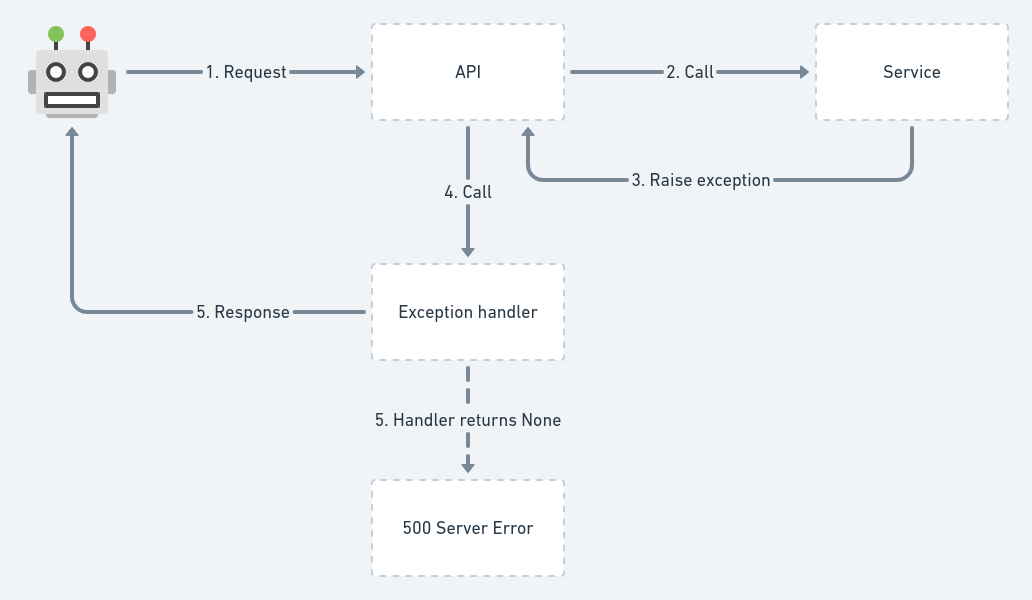
Basically, if the exception handler cannot handle the given exception & returns `None`, this will result in an unhandled exception & a `500 Server Error`. This is often good, because you won't be silencing errors, that you need to pay attention to.
**Now, there are some quirks, that we need to pay attention to.**
#### DRF's `ValidationError`
For example, if we simply raise a `rest_framework.exceptions.ValidationError` like that:
```python
from rest_framework import exceptions
def some_service():
raise ValidationError("Error message here.")
```
The response payload is going to look like this:
```json
["Some message"]
```
This looks strange, because if we do it like this:
```python
from rest_framework import exceptions
def some_service():
raise exceptions.ValidationError({"error": "Some message"})
```
The response payload is going to look like this:
```json
{
"error": "Some message"
}
```
That's basically what we passed as the `detail` of the `ValidationError`. But it's a different data structure from the initial array.
Now, if we decide to raise another of the DRF's built-in exceptions:
```python
from rest_framework import exceptions
def some_service():
raise exceptions.NotFound()
```
The response payload is going to look like this:
```json
{
"detail": "Not found."
}
```
That's entirely different from what we saw as behavior from the `ValidationError` and this might cause problems.
So far, the default DRF behavior can get us:
- An array.
- A dictionary.
- A specific `{"detail": "something"}` result.
**So if we need to use the default DRF behavior, we need to take care of this inconsistency.**
#### Django's `ValidationError`
Now, DRF's default exception handling is not playing nice with Django's `ValidationError`.
This piece of code:
```python
from django.core.exceptions import ValidationError as DjangoValidationError
def some_service():
raise DjangoValidationError("Some error message")
```
Will result in an unhandled exception, causing `500 Server Error`.
This will also happen if this `ValidationError` comes from model validation, for example:
```python
def some_service():
user = BaseUser()
user.full_clean() # Throws ValidationError
user.save()
```
This will also result in `500 Server Error`.
If we want to start handling this, as if it was `rest_framework.exceptions.ValidationError`, we need to roll-out our own [custom exception handler](https://www.django-rest-framework.org/api-guide/exceptions/#custom-exception-handling):
```python
from django.core.exceptions import ValidationError as DjangoValidationError
from rest_framework.views import exception_handler
from rest_framework.serializers import as_serializer_error
from rest_framework import exceptions
def custom_exception_handler(exc, ctx):
if isinstance(exc, DjangoValidationError):
exc = exceptions.ValidationError(as_serializer_error(exc))
response = exception_handler(exc, ctx)
# If unexpected error occurs (server error, etc.)
if response is None:
return response
return response
```
This is basically the default implementation, with the addition of this piece of code:
```python
if isinstance(exc, DjangoValidationError):
exc = exceptions.ValidationError(as_serializer_error(exc))
```
Since we need to map between `django.core.exceptions.ValidationError` and `rest_framework.exceptions.ValidationError`, we are using DRF's `as_serializer_error`, which is used internally in the serializers, just for that.
With that, we can now have Django's `ValidationError` playing nice with DRF's exception handler.